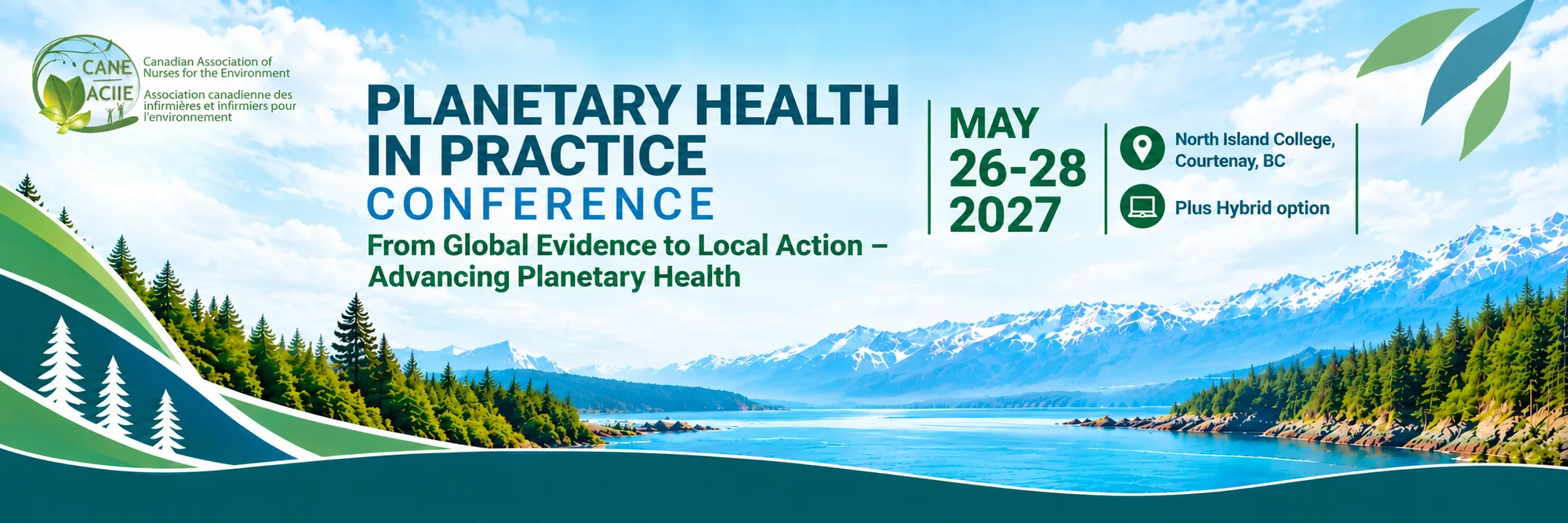
From Global Evidence to Local Action - Advancing Planetary Health
Welcome to our first Planetary Health conference!
This conference will bring together nurses, midwives, healthcare providers, researchers, educators, community leaders, and policymakers to explore how planetary health can be integrated into everyday nursing and midwifery practice, with a particular focus on leadership and bridging the gap between knowledge and action, as well as health promotion.
The conference will prioritize practical solutions and collaborative learning, moving from global concepts to real-world implementation across diverse care settings.
Call for Abstracts
Share your work at From Global Evidence to Local Action! We welcome abstracts advancing planetary health through practice, education, research, policy, and community action. Innovative approaches, student submissions, proposed projects, and work in progress are encouraged, with priority given to nursing, midwifery, and transdisciplinary initiatives. Make an account, view details and submit your abstract by December 11.
Conference Structure
The conference will include in-person and hybrid delivery over three days. The first day features a pre-conference workshop; day two and three will offer multiple sessions and speakers.
Pre-Conference Workshop: Place-Based Planetary Health Nursing: Building Capacity for Local Action
Join us for an engaging, one-day interactive workshop exploring how nurses can translate planetary health knowledge into meaningful local action. Climate change, biodiversity loss, pollution, and environmental inequities increasingly shape health outcomes and healthcare delivery. This workshop will connect planetary health evidence with local contexts, equity, and practical strategies for action.
Grounded in five domains of the Planetary Health Education Framework, the workshop will explore the interconnections between nature and health, the Anthropocene, equity and social justice, movement building and systems change, and systems thinking and complexity. Led by a team of planetary health specialists and student facilitators coordinated by Shona Lalonde, participants will engage in experiential learning through systems mapping, reflective exercises, environmental justice cases, Indigenous-informed approaches, collaborative problem-solving, and action planning.
Whether you are an educator, clinician, researcher, student, or community partner, you will gain foundational knowledge, practical tools, and confidence to integrate place-based planetary health approaches into nursing education, clinical practice, public health initiatives, and community partnershi
Main Conference and Strategy Building Session (2 days)
The two-day conference will focus on leadership, knowledge translation, and real-world implementation, culminating in a strategy-building session to shape our collective future.
Day 1 - Global Perspectives and Emerging Evidence
The goal of this day is to establish shared understanding and highlight emerging evidence and frameworks.
Day 2 - From Evidence to Practice
The second day will focus on implementation and applied leadership
Conference Speakers
The conference will include in-person and hybrid speakers during Days 1 and 2. Below is a preliminary list of highlighted sessions that will be presented.
Learn from Leaders. Connect Across Disciplines. Inspire Action.
Join leading voices in planetary health, nursing, environmental sustainability, Indigenous knowledge, and community-engaged practice. Through dynamic workshops, inspiring presentations, and opportunities for meaningful dialogue, you’ll engage with some of the most influential and innovative thinkers and practitioners in the field. Discover new perspectives, share knowledge, build connections, and explore how we can translate global evidence into meaningful local action.

The climate crisis affects not only environmental systems but also emotional well-being, relationships, and connections to place. This interactive hybrid workshop, led by Émilie Tremblay, explores earth emotions, climate-related distress, and ecogrief through ecofeminist and intergenerational perspectives. Drawing on research on young climate activists and non-activists, participants will use lived experience and arts-based methods to explore how environmental degradation shapes emotional responses and collective engagement. Adapted for in-person and online participation, the workshop will use facilitated dialogue, digital breakout rooms, and collaborative tools to foster connection across settings. Participants will identify meaningful pathways from emotional reflection toward collective action, strengthening their capacity to support youth engagement, relational connections to the land, and regenerative approaches to planetary health.

Climate change increasingly threatens population health, healthcare delivery, and health equity, underscoring the need to integrate planetary health into healthcare practice, education, and organizational decision-making. This presentation will explore evidence-informed approaches to climate resilience and sustainable healthcare, drawing on Zerina Lokmic-Tomkins' expertise in nursing, digital health, and health professions education. It will examine opportunities to translate global planetary health evidence into locally relevant approaches in the context of maternal and child health that strengthen healthcare system resilience, reduce environmental impacts, and address climate-related health vulnerabilities. Particular attention will be given to the role of nursing leadership, educational innovation, and interdisciplinary collaboration in advancing implementation across diverse healthcare contexts. By connecting research, policy, and practice, the presentation will highlight opportunities to embed planetary health into professional education and healthcare delivery, supporting more equitable, climate-resilient, and environmentally sustainable health systems.

Health professionals are increasingly recognizing that the conditions shaping planetary health. including climate change, pollution, fossil-fuel dependence, and environmental inequities, are also matters of public policy. Yet translating health evidence into meaningful policy change requires more than communicating research: it requires strategic advocacy, coalition-building, effective messaging, and engagement with decision-makers and communities.
Drawing on the Canadian Association of Physicians for the Environment's (CAPE), transdisciplinary experience in advancing environmental health policy and advocacy, this interactive workshop will explore how health professionals can move from evidence and concern to collective action. Through selected examples of successful advocacy campaigns, facilitators will examine how health professionals have leveraged scientific evidence, professional credibility, public engagement, partnerships, and strategic opportunities to influence policy.
Participants will then apply these lessons to a planetary health issue relevant to their own communities or professional contexts. Working collaboratively, they will identify the policy problem, decision-makers, affected communities, potential allies, strategic opportunities, and evidence needed to support action. Participants will develop a concise advocacy message and a specific policy ask, followed by a practical action they can pursue after the conference.
The workshop emphasizes advocacy as a collective and relational practice. It will explore how health professionals can work alongside Indigenous Peoples, communities, researchers, environmental organizations, and other movements while centering equity, lived experience, and community priorities.
By the end of the session, participants will have a practical framework for translating planetary health evidence into policy advocacy and concrete local action.

Planetary health education requires approaches that connect environmental and human health with the places, relationships, and knowledge systems that shape community well-being. This interactive workshop explores how place-based and land-based learning can deepen planetary health education by bringing Western scientific evidence, Indigenous knowledge, arts-based approaches, and community experience into dialogue. Drawing on Angel Kennedy's work at the intersections of eco-social public health, climate resilience, youth well-being, and Indigenous-led land-based learning, participants will explore how relationships with land and water can strengthen understandings of the interconnected determinants of health, foster relational accountability, and inform culturally responsive approaches to learning. Through reflective, experiential, and participatory activities, participants will consider how diverse ways of knowing can inform nursing and health professional education, strengthen connections between health, place, and environment, and support locally relevant responses to environmental change. The workshop will invite participants to identify opportunities to integrate place-based approaches into their own educational, research, and community contexts, while attending to the importance of Indigenous leadership, knowledge sovereignty, reciprocity, and respectful relationships with land and communities.

Food systems are integral to planetary health, influencing greenhouse gas emissions, biodiversity, land and water use, ecosystem integrity, and human health. This interactive workshop will connect environmental and public health evidence, Canada's Food Guide, and the EAT-Lancet Planetary Health framework with practical opportunities for institutional change. Dr. David Steele (EarthSave Canada) and Holly Moriarity (Plant-Based Cities Movement, Alberta Regional Lead), alongside colleagues from partner organizations, will explore plant-forward food systems and initiatives in healthcare, municipalities, and post-secondary institutions. Through case studies and facilitated dialogue, participants will examine strategies for advancing sustainable food procurement, plant-forward menus, and plant-based-by-default approaches, including engaging champions, addressing implementation barriers, and building organizational support. Collaborative activities will help participants identify locally relevant opportunities and develop actionable 60--90-day plans. Participants will leave with evidence-informed strategies and practical next steps for translating knowledge and professional leadership into meaningful institutional action that supports planetary and human health.

Frequently Asked Questions
Find quick answers to common questions about the conference.
Head over to our registration page, and complete the online form. Select your ticket type, provide the required information, and submit payment to secure your spot.
The conference schedule is available on the website. It includes a detailed list of sessions, workshops, keynote speakers, and networking events. Check the schedule regularly for updates and changes.
Yes, there are hotels and accommodations close to the conference venue.
Yes, you can submit a presentation proposal during the open call for speakers. Visit the 'Submission' page on the website, and follow the submission guidelines provided.
Our Sponsors
We are grateful to our sponsors who made this conference possible.
Location
Hybrid event:
Hybrid - In person at North Island College, Courtenay, BC
2300 Ryan Road
Courtenay, British Columbia
Canada, V9N 6Z3
Dates
Registration period:
December 1, 2026 - 9:00 AM MST - May 1, 2027 - 9:00 PM MST
Submission period:
October 19, 2026 - 8:00 AM PDT - December 11, 2026 - 9:00 PM MST
Contact us
If you have any questions, please contact conference@cane-aiie.ca