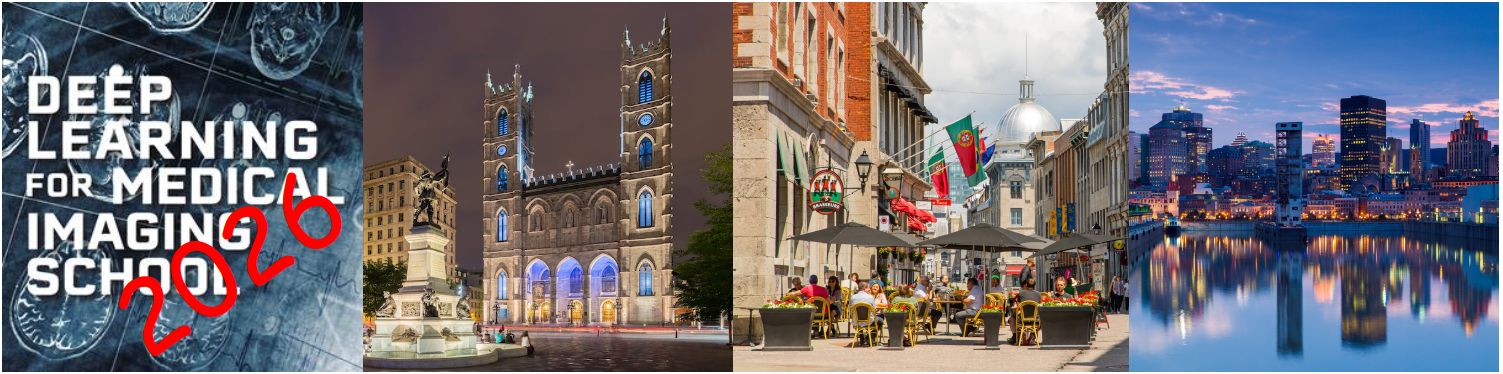
2026 Summer school on deep learning for medical imaging, 7th Edition
Welcome to the 2026 summer school on deep learning for medical imaging!
This school is intended for medical imaging beginners and experts (students, post-docs, research professionals, and professors) who are eager to discover the fundamentals of deep learning and how it translates to medical imaging. We will walk you through the basics of machine learning all the way to the latest deep learning breakthroughs applied to medical imaging. As shown in the planning, the school has both oral presentations (15 hours) and 5 hands-on sessions of 3 hours each. During the hands-on sessions, the participants will be guided through the dos and don'ts of machine learning programs for medical imaging. Please see the program for more details.
Should you be a machine learning / deep learning expert to attend the school? NO! That is the point of this school!
Should you be a programming expert to attend the hands-on session? NO! Only basic skills in Python programming are required.
We have enough room to accommodate 70 on-site participants. So do not wait and register!
Since we anticipate that more than 70 people will register to our summer school, we will grant the possibility for people to virtually attend the school in an asynchronous manner. These virtual participants will not be permitted on-site participation but will have access to the recorded videos as well as the hands-on session material towards the end of the school.
This school is sponsored by MICCAI, the Medical Image Computing and Computer Assisted Intervention Society!
Important Dates
· February 3rd, 2026: Registration opening
· June 1st, 2026: Registration cancellation deadline (only for visa issues)
· June 2nd, 2026: Registration deadline
· June 15-19, 2026: Summer school
· June 18, 2026: Evening event (Chateau Ramezay)
Onsite requirements
Those participating to the onsite event need to bring a laptop computer with a working WIFI connection. The hands on sessions will be held on the Compute Canada servers. So no need for a fancy hardware nor a specific operating system. And... oh yes! bring a happy face, it will be fun!
People working in research are also invited to bring a poster presenting their work (published or not). That is a great way of sharing your expertise with others.
Oral presentation and hands on material
Please click here to get the recordings of the oral presentations as well as the material for the hands on sessions.
Rates (subject to modifications between now and Feb 1st)
375CAN$ for students
465CAN$ for non-students
130CAN$ for virtual asynchronous participation
Several promotion codes! 75% of the registration fees for ETS and Sherbrooke students.
Inclusions
For the on-site participants, fees include 5 days of classes and hands-on sessions, coffee breaks, lunches, welcome cocktail and evening event at the museum. Please note that those fees do NOT include hotel.
Cancellation policy
NO REFUND POLICY: Please note that we shall provide NO REFUND under any circumstances outside visa problems. We are aware that getting a visiting visa can be difficult for some. For that reason, we shall allow a refund (with a transaction fee of 20 CAN$ - courtesy of the international banking system) before June 1st, 2026 for those experiencing a visa problem. NO REFUND will be allowed after that date however. If you need an invitation letter, please contact jose.dolz@etsmtl.ca.
The following hotels are nearby the venue:
Best Western Plus Montreal Downtown- Hotel Europa (Walking distance from ETS: 1.0 km)
Novotel Montreal Center (Walking distance from ETS: 1.0 km)
Montreal Marriott Chateau Champlain (Walking distance from ETS: 500 m)
Hotel Bonaventure Montreal (Walking distance from ETS: 500 m)
Hôtel Alt Montréal (Walking distance from ETS: 500 m)
Best Western Ville-Marie Hotel & Suites (Walking distance from ETS: 1.3 km)
Visa
Most people need a visitor's visa or an Electronic Travel Authorization (eTA) to travel to Canada - not both. Some people may only need their valid passport. List of visa-exempt countries. You can find out if you need a visa here.
For those who need a visa, more information can be found on the Canada immigration website. Also, please send us an email for a letter of invitation (required to apply for a visa).
NOTE : please bear in mind that applying for a Canadian Visa may take up to three months.
How to reach us
The summer school will be held in Pavillon A of the ETS (Ecole de Technologie Supérieure) of Montreal, located at the corner of Peel and Notre-Dame streets. The exact address is 1100 Notre-Dame St W, Montreal. The auditorium room number is A-1600
By metro : One easy way of reaching the ETS is through the subway. Hop into the nearest metro station to your hotel, go to the Lucien L'allier or Bonavanture stations on the orange line, and walk to the ETS (5 minute walk).
By bicycle: Where ever you are in Montreal, you can easily bike your way around through a large network of cycle paths. In fact, Montreal has been ranked the 18th most bicycle friendly city in the world according to the Copenhagen index. Don't have a bike? No problem, rent a bixi! With 700 bixi stations, you probably have one right next to your Hotel. https://www.bixi.com/
By car: You may drive to the ETS which has an underground parking lot. But beware! the parking can be full!
By bus: The bus lines 35, 36, 74 and 107 passes near the ETS. Click here for a bus map. You may also go on the Montreal transit society web site for more details.
· Pierre-Marc Jodoin (Université de Sherbrooke, Canada)
· Christian Desrosiers (École de technologie supérieure, Canada)
· Jose Dolz (École de technologie supérieure, Canada)
· Thomas Grenier (INSA Lyon, CREATIS, France)
· Sylvain Bouix (École de technologie supérieure, Canada)
· Valentine Wargnier (INSA Lyon, CREATIS, France)
· Heber Hwang Arcolezi (École de technologie supérieure, Canada)
· Michaël Sdika (INSA Lyon, CREATIS, France)
· Carole Frindel (INSA Lyon, CREATIS, France)
We're thrilled to organize the 7th edition of our summer school. This summer school is aimed at both novice and more experienced researchers in medical imaging who wish to deepen their knowledge in machine learning and its application to various problems in this field. As before, the school will accommodate for on-site and virtual participation.
The school consist of talks, poster sessions, networking sessions, a round table discussion and 4 hands on sessions.
Sponsorship Tiers
Gold $3000+
Acknowledgements during introductory talk.
T-Shirts of the summer school
* Opportunity for an oral presentation from a member of the sponsor organization
* Logo on the conference's splash screen
* Logo on the summer school website
Silver $1500
Logo on the conference's splash screen
Logo on the summer school website
Bonze $750
* Logo on the summer school website
How are we planning on spending the budget ?
The budget will be used for expenses related to the conference logistics. We are seeking financial support to contribute towards the stipends of students who are integral to the organization of our summer school, as well as to fund the GPU usage from the Saturn Cloud provider.
Unused budget
As for the previous editions of the summer school, any remaining budget will be rolled over to next year’s event.
The previous editions of the school on deep learning for medical imaging were held in 2019 at the Université de Lyon, France and online in 2021, then at the ETS in 2022 and back in Lyon in 2023, at the ETS in 2024, back in Lyon in 2025. These schools were organized with the full logistic support of the ETS, the Université de Sherbrooke and the CREATIS lab.
Meet our speakers!
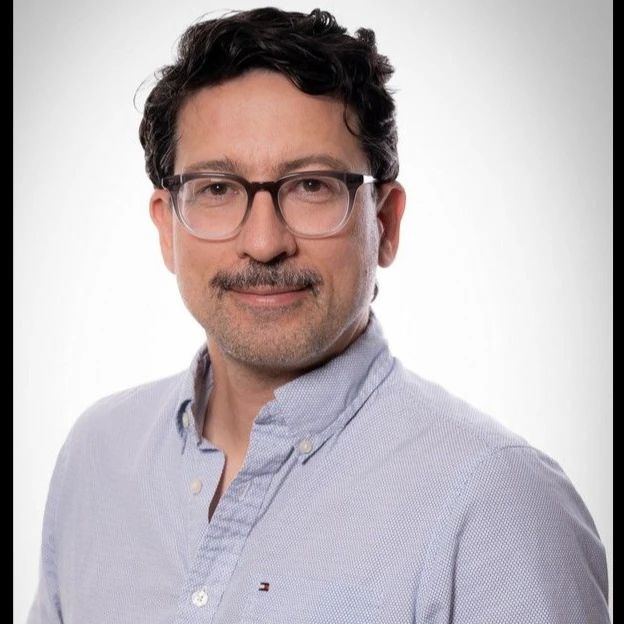
Pierre-Marc Jodoin is from the University of Sherbrooke, Canada where he works as a full professor since 2007. He specializes in the development of novel techniques for machine learning and deep learning applied to computer vision and medical imaging. He mostly works in video analytics and brain and cardiac image analytics. He is the co-director of the Sherbrooke AI platform and co-founder of the medical imaging company called "Imeka.ca" which specializes in MRI brain image analytics. web site: jodoin.github.io
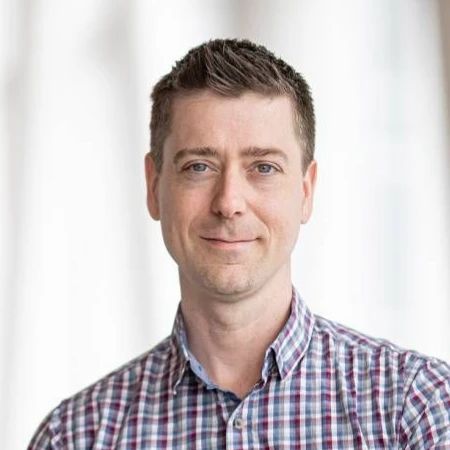
Prof. Desrosiers obtained a Ph.D. in Applied Mathematics from Polytechnique Montreal in 2008, and was a postdoctoral researcher at the University of Minnesota with prof George Karypis. In 2009, he joined École de technologie supérieure (ÉTS) as professor in the Departement of Software and IT Engineering. He is codirector of the Laboratoire d’imagerie, de vision et d’intelligence artificielle (LIVIA) and a member of the REPARTI research network. He has over 100 publications in the fields of machine learning, image processing, computer vision and medical imaging, and has served on the scientific committee of several important conferences in these fields.
Dr. Thomas Grenier is Associate Professor at the University of Lyon Electrical Engineering department and at the CREATIS lab in Lyon, France. His research focuses on longitudinal analysis of medical data to study evolution as Multiple Sclerosis lesions, functional activity (muscle and hydrocephaly). Most of these studies involve a segmentation task and dedicated pre and post processing steps. Clustering (spatio-temporal mean-shift), semi-supervised (multi-atlas with machine learning) or fully supervised (DNN) schemes are used to solve such problems considering their specific constraints.
Michaël Sdika is a full member of the CREATIS lab in Lyon, France. His current research field focuses on the development of new analysis method based on deep learning for medical data. His main contributions are centered around image registration, atlas based segmentation, structure localization and machine learning for MR image of the nervous central system.
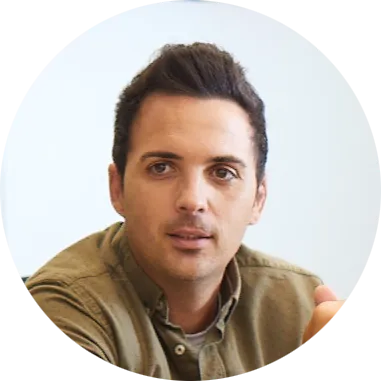
Jose Dolz is Associate Professor in the Department of Software and IT Engineering at the École de Technologie Supérieure (ETS) Montreal. Prior to be appointed Assistant Professor, he was a post-doctoral fellow at the ETS Montreal. Prof. Dolz obtained his B.Sc and M.Sc in the Polytechnic University of Valencia, Spain, and his Ph.D. at the University of Lille 2, France, in 2016. He was recipient of a Marie-Curie FP7 Fellowship (2013-2016) to pursue his doctoral studies. His current research focuses on deep learning, medical imaging, optimization and learning strategies with limited supervision, as well as enhancing the uncertainty quantification of these models. He authored over 100 fully peer-reviewed papers, many of which published in the top venues in medical imaging (MedIA/TMI/MICCAI/IPMI), computer vision (CVPR, ECCV, ICCV) and machine learning (NeurIPS, ICML, ICLR), organized 6 tutorials at MICCAI, and has been recognized multiple times as Outstanding Reviewer (MICCAI'20, ECCV'20, CVPR'21, CVPR'22, NeurIPS'22, ICCV'23, CVPR'25).
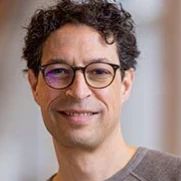
Sylvain Bouix is a professor in the Department of Software Engineering and IT at the École de technologie supérieure (ÉTS) in Montreal and Canada Research Chair in Neuroinformatics for Multimodal Data. He earned his engineering degree from UTBM in France, an M.Sc. in Computer Science from the University of Kansas, and a Ph.D. from McGill University. Before joining ÉTS in 2022, he spent nearly two decades at the Psychiatry Neuroimaging Laboratory of Brigham and Women’s Hospital and Harvard Medical School, where he developed advanced methods for brain morphometry, diffusion MRI, and multimodal neuroimaging. His research focuses on AI-driven analysis of complex neuroimaging datasets, the integration of multimodal biomarkers, and the development of robust computational tools to study psychiatric and neurological disorders.
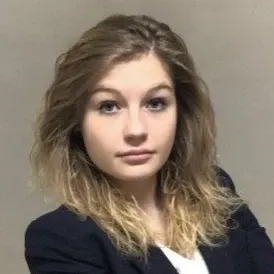
Valentine Wargnier-Dauchelle is a Maître de conférences (Associate Professor) at the CREATIS research laboratory of INSA Lyon in France, where she works at the intersection of artificial intelligence, deep learning, and medical imaging. Her research interests include computer vision and explainable machine learning methods for biomedical image analysis, with contributions to topics such as interpretable neural networks and segmentation in medical contexts.
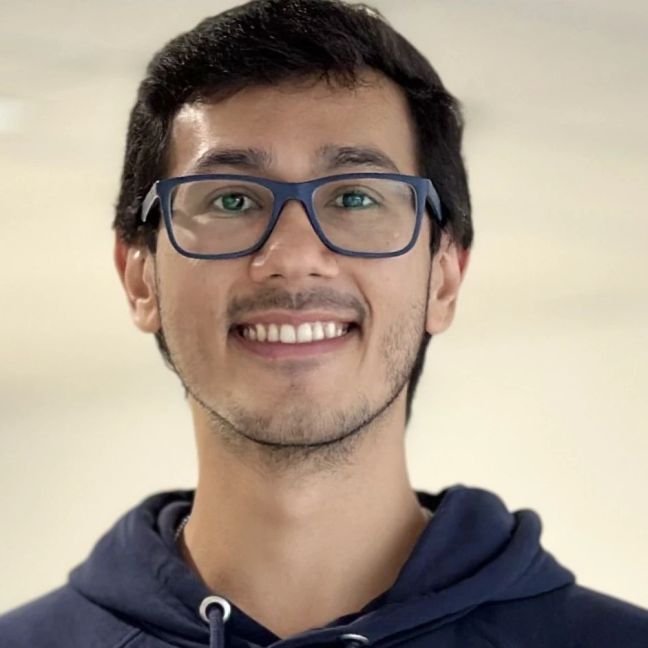
Héber Hwang Arcolezi is an Assistant Professor in the Department of Software and IT Engineering at École de Technologie Supérieure (ÉTS Montréal), Canada. He received his Ph.D. in Computer Science from Université Bourgogne Franche-Comté in 2022, followed by a postdoctoral fellowship at Inria Saclay and École Polytechnique. Before joining ÉTS Montréal, he was a tenured research scientist at Inria Grenoble (France). His research lies at the intersection of privacy-preserving and fair machine learning, with a particular emphasis on the algorithmic auditing of anonymization and differential privacy mechanisms. Within the broader scope of Responsible AI, his work investigates how privacy-enhancing technologies impact the trustworthiness, robustness, and accountability of AI systems. https://hharcolezi.github.io/
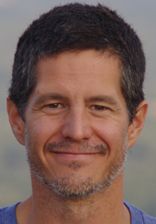
His research interests include machine learning and deep learning for understanding low-level signals, e.g. vision, time series, acoustics, etc. He also explores solutions for combining low-level and higher-level data for multi-modal data processing. His current application domains are essentially targeted towards healthcare, physics and autonomous vehicles. He is involved in several French, European and international collaborative research projects on artificial intelligence and deep learning.
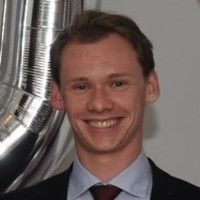
Thierry Judge is pursuing a joint PhD at the University of Sherbrooke and INSA Lyon. His current research focuses on estimating cardiac motion using ultrasound images. A key part of his work is on uncertainty estimation for deep learning models, an approach he has previously
applied to cardiac segmentation and is now extending to motion estimation.
Our Sponsors
We are immensely grateful for your generous financial support towards the organization of the 2026 Deep Learning for Medical Imaging Summer School. Your contribution has played a pivotal role in making this educational event possible and successful.






Location
Hybrid event:
École de technologie supérieure - ETS Montréal, CANADA
1100 Rue Notre-Dame Ouest
Montréal, Québec
Canada, H3C
Dates
Registration period:
February 3, 2026 - 8:56 AM EST - June 2, 2026 - 11:59 PM EDT
Contact us
If you have any questions, please contact pierre-marc.jodoin@usherbrooke.ca