Joint Annual Meeting of the Entomological Societies of Quebec and Canada 2024
Hôtel Le Concorde
October 20-23, 2024

Welcome!

The Société d'entomologie du Québec is pleased to invite you to the Joint Annual Meeting of the Entomological Society of Canada and the Entomological Society of Quebec. The JAM will take place from October 20 to October 23, 2024, in the charming provincial capital, Québec.

Come back frequently to find the latest news!

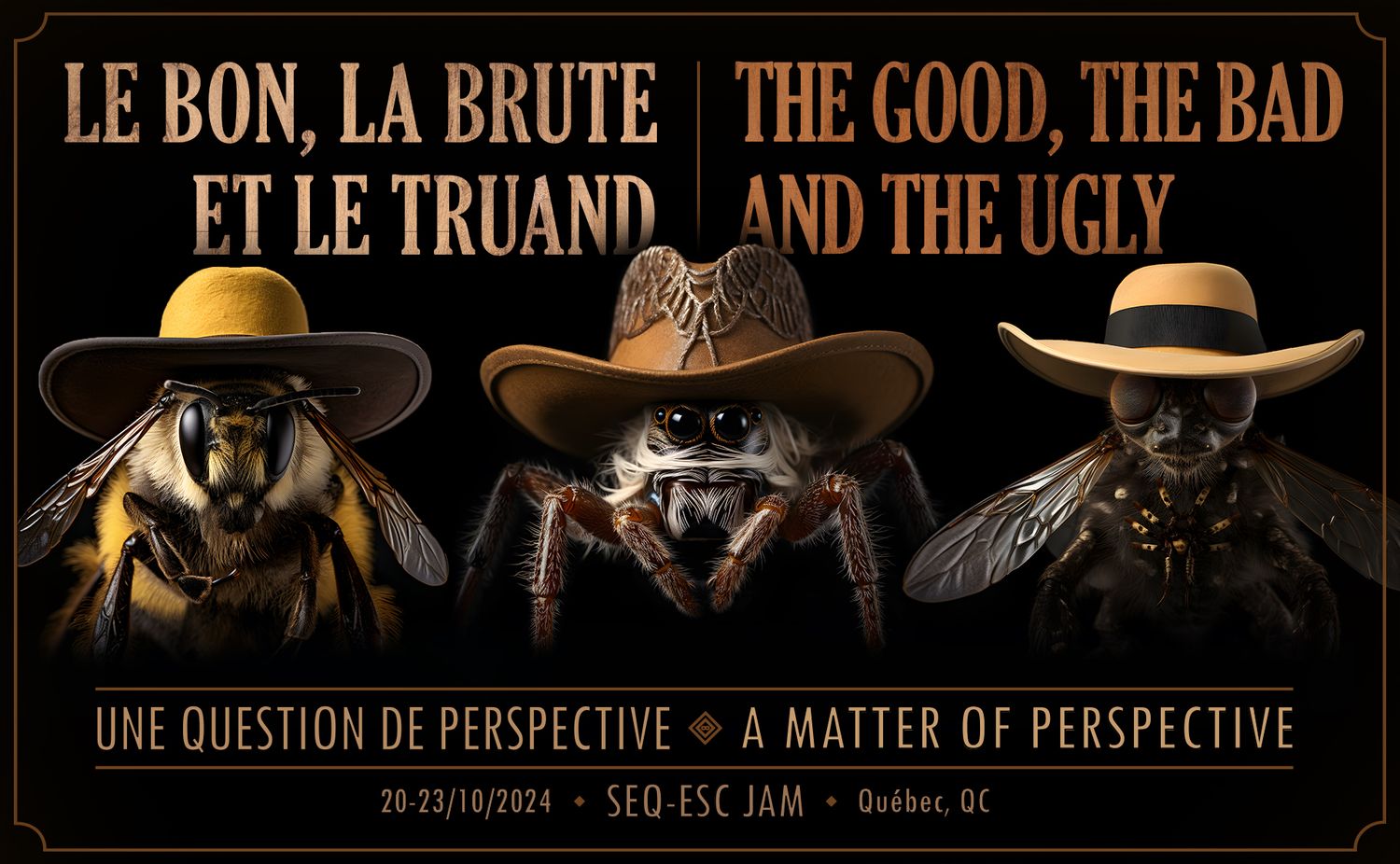
The theme of the JAM will be: The Good, The Bad and The Ugly - A Matter of Perspective

Welcome to Québec!

You will find here a short words from the Presidents of both societies and from the organizing committee.

Keynote Speakers

Dr Samuel RamseyCU Boulder’s BioFrontiers Institute

Dr Ramsey received his B.S. in entomology from Cornell University and his Ph.D. in entomology from the University of Maryland College Park. He completed his post-doctoral training with Dr. Jay Evans, Steve Cook, and Daniel Sonenshine at USDA-ARS Bee Research Laboratory and now serves as Endowed Professor of Entomology at CU Boulder’s BioFrontiers Institute and the Ecology and Evolutionary Biology Department. Featured on Hulu’s Docuseries: Your Attention Please as well as in the Washington Post, on NPR, CNN, Wired, CBS This Morning, Khan Academy, Seeker, The Today Show and several local news segments, Ramsey is celebrated as an engaging science communicator. He uses this talent to make science more accessible to a broad audience. His nonprofit, The Ramsey Research Foundation, works to remove barriers that slow the progress of and decrease access to science by developing novel pathways for scientific funding and by removing paywalls that keep the public from engaging with published scientific work.

Dre Sasha LuccioniHugging Face

Dr Sasha Luccioni is a researcher in ethical and sustainable artificial intelligence at Hugging Face, as well as a Founding Member of Climate Change AI and a Board Member of Women in Machine Learning. Her work focuses on having a better understanding of the societal and environmental impacts of AI models, datasets and systems. She has been called upon by organizations such as the OECD and the United Nations as an expert in developing norms and best practices for a more sustainable and ethical practice of AI, and she was recently named one of MIT Tech Review's 35 Innovators Under 35 for her work on sustainable AI.

Dr Alberto Urbaneja Instituto Valenciano de Investigaciones Agrarias

Throughout his career, Dr Alberto Urbaneja has addressed numerous key pests in horticultural crops like tomatoes and peppers, as well as in evergreen crops such as citrus. In each instance, his goal has been to establish pest management programs that emphasize biological control. In his forthcoming presentation at the Canadian Entomological Society on zoophytophagous predators, his initial work focused on selecting a species of predatory mirid for commercial breeding suitable for southern Spain. For this project, Nesidiocoris tenuis was selected as a highly effective yet controversial predator because of its potential to damage crops. Since then, Alberto has been investigating the use of N. tenuis and other mirids, studying the plant defences these predators induce, and developing strategies to minimize the impact of the damage they can cause.

Alberto has authored over 400 publications, including 171 in SCI-indexed journals, and has led 21 out of 42 research projects. His commitment to knowledge transfer is evident through numerous outreach activities. He has secured 31 research contracts with agricultural companies and has fostered collaborations with public institutions for practical agricultural applications.

Alberto has supervised 16 doctoral theses, mentored postgraduate students and postdoctoral fellows, and hosted research internships for over 50 individuals. He has also served in editorial roles. Alberto's contributions extend to scientific committees, evaluation commissions, and consultancy work for international organizations.

Dr David RolnickMcGill University

David Rolnick is an Assistant Professor and Canada CIFAR AI Chair in the School of Computer Science at McGill University and at Mila Quebec AI Institute, where his work focuses on applications of AI to help address the climate and biodiversity crises. He is a Co-founder and Chair of Climate Change AI, Scientific Co-director of Sustainability in the Digital Age, and Canada lead for the NSF-NSERC Global Center on AI and Biodiversity. Dr Rolnick received his Ph.D. in Applied Mathematics from MIT. He is a former NSF Mathematical Sciences Postdoctoral Research Fellow, NSF Graduate Research Fellow, and Fulbright Scholar, and was named to the MIT Technology Review’s 2021 list of “35 Innovators Under 35.”

Local Organizing Committee:

General Chair: Joseph Moisan-De Serres

Local Arrangements Chair: Valérie Fournier

Treasurer: Mario Fréchette

Scientific Program: Geneviève Labrie, Julien Saguez et Sébastien Boquel

Fundraising: Raymond-Marie Duchesne et Sébastien Boquel

Communications and social media: Étienne Normandin

Website: Véronique Martel

Program: Christine Jean

Registration: Valentine Glaus


List of Symposia

Please note that the language of the titles and descriptions is the one it was submitted in.

Organizers: Jacinta Kong and Matthew Muzzatti


Rearing insects en masse is crucial for numerous industries, including biocontrol agents for pest management, laboratory populations, and the insects as food and feed sector. Academic institutions, industrial companies, and government all feed into the sustained development of the industry through improvements to the farming process, the development of policy and regulations, and ensuring there is enough supply to meet demand for insect agriculture. Recent advances in our understanding of fundamental insect biology and the rapid development and adoption of emerging technologies have also poised the insect mass rearing industry for rapid growth in Canada. Examples include monitoring of biotic and abiotic conditions to leverage our developing understanding of insect growth and development, machine learning and automation for collecting large quantities of data and reducing dependence on manual labour, and the development of sustainable practices. Thus, insect mass rearing relies on collaborative interdisciplinary partnerships to drive advancements, but these partnerships are not always established, and communication between relevant mass-rearing enterprises can be minimal. This symposium will be an integration of experts from academia and industry working on various aspects of insect mass rearing with the goals of showcasing recent advances in the Canadian insect mass-rearing industry and developing a roadmap for better implementation of policy and collaboration.

Organizers: Sabrina Rondeau and Susan Willis Chan


Wild insect pollinators are universally acknowledged as beneficial contributors to ecosystems, embodying the 'good’. This symposium invites researchers, practitioners, and pollinator enthusiasts to explore the core methodologies essential for studying wild pollinators. Rather than showcasing research results, the focus of this session is on sharing robust methods and techniques that underpin effective pollinator research. Themes within this symposium encompass a wide array of methodological approaches. From genetic tools elucidating population dynamics to field and laboratory methods for studying various bee species, attendees will learn about techniques for behavioural, ecotoxicological, and ecological research as well as for species conservation, including those at risk. Moreover, discussions will extend to innovative methodologies such as radio-telemetry and approaches for studying cognition in wild bees. Sampling methods, community science initiatives, and more will also be explored. This symposium offers a collaborative platform for advancing methodologies in wild pollinator research.

Organizers: Evelyne Barrette and Louis Morneau


Le symposium explorera les différentes initiatives et projets où les connaissances en entomologie forestière ont été mises en valeur et intégrées à la pratique pour contribuer à une meilleure gestion des insectes dans les forêts du Québec. Les principaux sujets abordés seront :• Les réseaux de suivi et d’acquisition de connaissances;• Les projets de recherche;• Le patrimoine entomologique;• Les outils d’aide à la décision.

Organizer: Jens Roland


This symposium focuses on the role of long-term studies of forest insect population dynamics. We highlight some of these studies as providing new insights into forest insect dynamics, and in doing so illustrate the value of long-term population studies. This symposium is particularly poignant with the recent passing of Dr. Tom Royama, CFS Atlantic, who helped pioneer much of our understanding of forest insect population dynamics.

Organizers: Meghan Vankosky and Véronique Martel


What is good, bad, and ugly might be a matter of perspective, but pests of agriculture and forestry are almost always bad for the plants they consume (or compete with, in the case of weeds) and for the humans that rely on those plants for food and fibre. Canada has a rich history of using biological control as a component of IPM programmes to manage insects, weeds, and plant pathogens. This history is documented in the book series, Biological Control Programmes in Canada and the newest version of this book will be available by fall 2024. This symposium, co-hosted by the co-editors of Biological Control Programmes in Canada, 2013-2023 will highlight a diverse array of the insect, weed, and plant pathogens that are targeted for biological control in Canada. Biological control programs of interest include long-running programmes and new programmes for new invasive species to Canada. The presentations will highlight the positive impacts of ‘good’ species (that might be ugly-looking) on ‘bad’ species (that might also be ugly-looking) and the importance of biological control as part of IPM programmes. 

Organizer: Joe Bowden


Deep learning and computer vision represents a disruptive technology: one that will substantially alter the way in which we detect, measure and identify insects for monitoring purposes. These rapidly advancing technologies, machine learning and camera systems (along with audio, and molecular tools like meta-barcoding), will greatly contribute to (but is not limited to) the detection of alien invasive species, irruptive pest insects, new species, and biodiversity -which is declining rapidly. This symposium aims to highlight projects underway that seek to advance our ability to detect, measure and identify this critically important and diverse group of animals and stimulate discussions on where we are, and where we need to go to in this field of 'automated entomology'.  

Organizers: Boyd Mori and Hector Carcamo


In this symposium, speakers will delve into the multifaceted realm of insect dynamics on the Canadian Prairies, uncovering both their positive contributions and detrimental impacts: the good, the bad, and the ugly. From exploring ecosystem services to unraveling complex environmental and insect stressors, a diverse array of speakers and topics will underscore a commitment to conserving and managing insects. Ultimately, topics covered in this symposium aim to enhance the sustainability of Prairie field crop production.

Your Societies

SEQ
SEC

Thanks to our financial partners!

Ville de Québec
Solida
Insectarium de Montréal
Québec Destination Affaires
MELCCFP/MAPAQ
CÉROM
Bayer Cropscience
BASF
Keyence
QCBS
Para-Bio
Anatis Bioprotection
CRAAQ
Trapview
Producteurs de grains du Québec
SPPQ
Plant Products
Université Laval
BioTEPP
Syngenta
GDG environnement
Maheu & Maheu
IRBV
Centre Sève
Koppert
Phytodata
Ressources naturelles Canada
Entosystem
CLEIC
TFIC
Ribozome
Génome Québec

Ce projet est financé par l’entremise du Programme Innovation bioalimentaire 2023-2028, Volet 5 - Soutien au transfert de connaissances et à la diffusion, en vertu du Partenariat canadien pour une agriculture durable, entente conclue entre les gouvernements du Canada et du Québec

Programme innovation bioalimentaire

Bienvenue à Québec!

Vous trouverez ici les mots de bienvenue des deux présidents et du comité organisateur.

Location

Hôtel Le Concorde

1225 Cours du Général de Montcalm

Québec, QC

Canada, G1R 4W6

Dates

Registration period:

September 29, 2023 - 8:53 AM EDT - October 14, 2024 - 11:30 PM EDT

Submission period:

May 1, 2024 - 12:00 AM EDT - September 21, 2024 - 12:00 PM EDT

Contact us

If you have any questions, please contact seq.esc2024@gmail.com

Powered by
Run your next event
with Fourwaves