Sponsors & Exhibitors
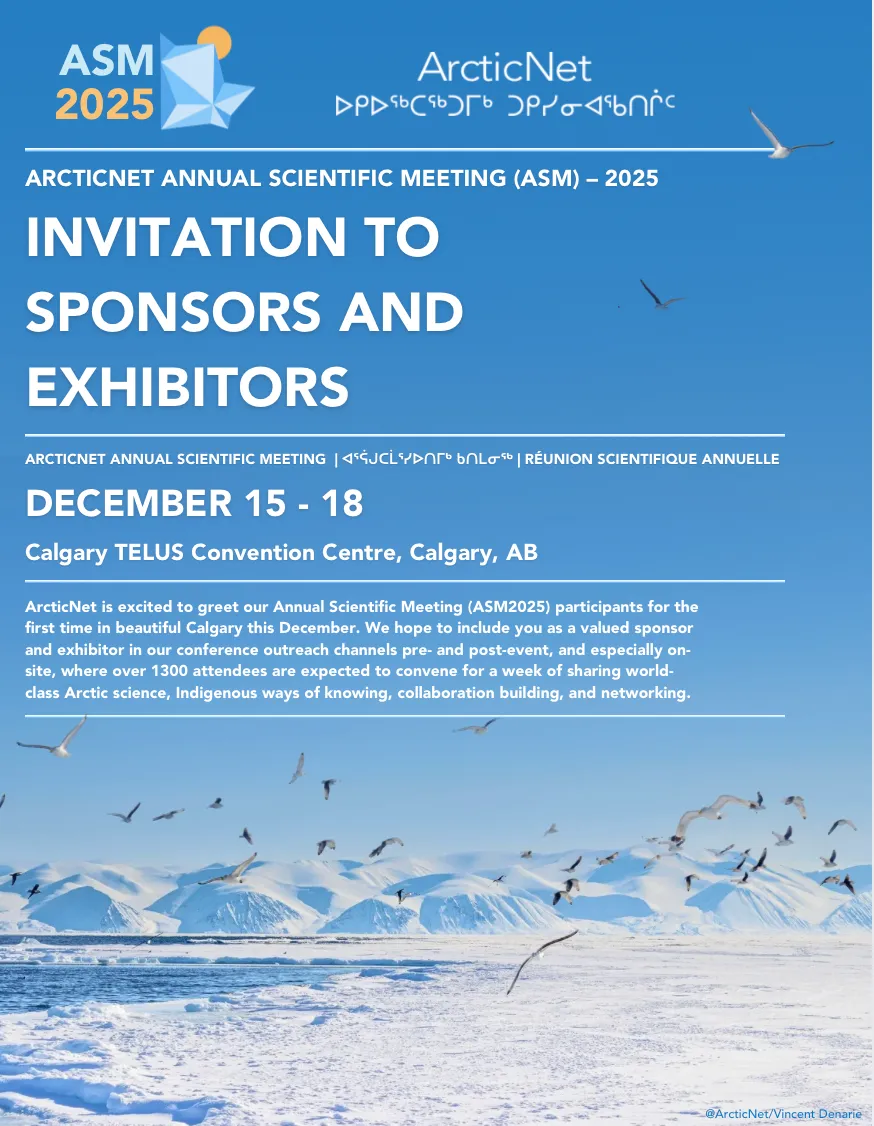
Supporting ArcticNet's Annual Scientific Meeting (ASM) 2025 is your opportunity to gain exposure and build relationships with hundreds of academic, scientists, research organizations, logistics providers, policy-and decision-makers, Inuit, First Nations, Métis, and northern residents, as well as private sector and non-governmental organizations, all with a vested interest in the Arctic. We invite you to view our prospectus to learn how you can support ASM2025!

ArcticNet's Annual Scientific Meeting (ASM) 2025 Prospectus
Thank you to this year's sponsors
INLANDSIS


ICEBERG


ICE RAFT


This year's exhibitors! Come visit their booths in Exhibition Hall C from December 16th-18th

Amundsen Science
Amundsen Science est responsable de la gestion du mandat scientifique du NGCC Amundsen, l’unique brise-glace canadien dédié à la recherche. Notre organisation s’engage à offrir un accès équitable au brise-glace de recherche, à son parc d’équipements scientifiques de pointe et à ses vastes ensembles de données.
Arctic Institute of North America, University of Calgary
The Arctic Institute of North America (AINA) is Canada's first and longest-lived Arctic research institute. AINA was created by an Act of Parliament in 1945 as a nonprofit tax-exempt research and educational organization and has been a part of the University of Calgary since 1976.

Arcticonnexion
Arcticonnexion is a non-profit, support organization striving to develop competencies in community-based monitoring, project management and leadership in Indigenous communities. Guided by equality & respect, we value genuine relationships and diverse knowledge systems to provide high-quality, ethical, and long-lasting impacts.

Birds Canada
Birds Canada is a bird conservation charity with the mission to drive action to increase the understanding, appreciation, and conservation of birds in Canada. Our Science in the North program brings our expertise in bird monitoring and habitat conservation to the North in support of Indigenous collaborators and priorities.

Braiding Knowledges Canada
BKC is dedicated to Reconciliation through Research, focusing on understanding and monitoring environmental change to inform conservation, restoration, and adaptation strategies. This is all in pursuit of our shared goal, enhancing the well-being of our environment and its people. Funded by the Strategic Science Fund.

Canada Foundation for Innovation
The CFI is a non-profit corporation that funds research infrastructure at Canadian universities, colleges, hospitals, and non-profit research institutions. | La FCI est une organisation à but non lucratif qui finance les infrastructures de recherche dans les universités, les collèges, les hôpitaux et les établissements de recherche à but non lucratif du Canada.

Canadian Science Publishing
Canadian Science Publishing is Canada’s largest independent, not-for-profit leader in mobilizing science-based knowledge. As a publisher of international scientific journals, we’re committed to strengthening the integrity, relevance, reach, and impact of vital knowledge and research, across Canada and around the globe.

Canadian Scientific Submersible Facility
The Canadian Scientific Submersible operates the Remotely Operated Vehicles ROPOS and ASTRID. We have experience in the Atlantic, Pacific, Arctic, Antarctic, and Indian Oceans.
CSSF enables research on benthic ecology, geology, sponge reefs, and corals. CSSF is known globally for its capabilities, efficiency, reliability, experienced operators, and mature systems.

Centre d'études nordiques
The Centre for Northern Studies (CEN) is an inter-institutional and multidisciplinary centre of excellence located at Université Laval (Québec). It gathers researchers, students, postdoctoral fellows and research professionals from various disciplines, who collaborate to improve our understanding of the terrestrial environments of the Arctic, subarctic, boreal and alpine regions.

Centre for Earth Observation Science (U Manitoba)
The Centre for Earth Observation Science (CEOS), housed in the Clayton H. Riddell Faculty of Environment, Earth, and Resources, is a leading multidisciplinary and collaborative research centre at the University of Manitoba focusing on understanding how the Earth will respond to climate change, primarily with a focus on the Arctic.

Cold Regions Research Centre
The Cold Regions Research Centre (CRRC) advances Arctic and sub-Arctic research through interdisciplinary collaboration, supporting early-career scholars, sustainability, and policy-relevant studies. Partnering with the GNWT and national institutes, it fosters research excellence, knowledge mobilization, and meaningful connections among researchers, communities, and governments to address cold regions challenges and opportunities

CIRNAC - Northern Contaminants Program
Northern Contaminants Program (NCP) engages Northerners and scientists in research and monitoring of long-range contaminants and plastic pollution in the Arctic. Its research supports assessments of ecosystem and human health, guides policy to eliminate global sources of contamination, and helps ensure the safety of traditional foods vital to Indigenous communities.
The Centre for Earth Observation Science (CEOS), housed in the Clayton H. Riddell Faculty of Environment, Earth, and Resources, is a leading multidisciplinary and collaborative research centre at the University of Manitoba focusing on understanding how the Earth will respond to climate change, primarily with a focus on the Arctic.

Department of National Defence
Defence Research and Development Canada (DRDC), including Innovation for Defence Excellence and Security (IDEaS), is working with Indigenous businesses to support Arctic sovereignty. We’re building partnerships, learning about Indigenous innovation, creating communication tools, and sharing knowledge to promote respectful research on Indigenous lands. Visit our booth to learn more!

Fisheries Joint Management Committee
The Fisheries Joint Management Committee (FJMC) was established in 1986, pursuant to the Inuvialuit Final Agreement (1984), to assist Canada and the Inuvialuit in the administration of rights and obligations related to the responsible co-management of fish, marine mammals, and their habitat in the Inuvialuit Settlement Region (ISR).

Government of Nunavut
The Fisheries and Sealing Division of the Government of Nunavut’s Department of Community Services operates the RV Nuliajuk, a 64-foot research vessel supporting fisheries surveys, ecological monitoring, and community-driven projects. The vessel strengthens collaboration among scientists, governments, and Nunavut communities, advancing sustainable research and resource priorities across the Arctic.

Indigenous Centre for Cumulative Effects
The Indigenous Centre for Cumulative Effects (ICCE) is an independent organization that supports Indigenous communities to undertake cumulative effects work. ICCE supports community-based approaches to manage the social, cultural, health, environmental and economic issues related to cumulative effects on every person, place and thing — because we are all connected.

Inuit Tapiriit Kanatami
ITK is the national organization ensuring Canadian Inuit prosper through unity and self-determination

JASCO Applied Sciences (Canada) Ltd
Cryosphere Innovation, part of the JASCO Applied Sciences Group, is a technology company that creates solutions for autonomously observing climate change in the Arctic. Cryosphere Innovation's hardware and software products derisk cold-environment data collection, enabling world-class research while fostering collaboration across the climate science community.

Kenn Borek Air Ltd
Kenn Borek Air is a diversified fixed wing aviation company specializing in Polar operations. With 50+ years of experience in Arctic and Antarctic operations, KBA is renowned for operational excellence performed in the world’s most extreme environments. KBA has year-round bases of operation at Iqaluit, Resolute Bay, Inuvik and Calgary.

Makivvik
Makivvik is mandated to protect the rights, interests and financial compensation provided by the JBNQA, and the more recent offshore NILCA. Makivvik’s distinct mandates ranges from operating businesses and generating jobs; to social economic development, improved housing conditions, to protection of the Inuit language and culture and the natural environment.

MEOPAR
MEOPAR (Marine Environmental Observation, Prediction and Response Network) is a national network that connects researchers, communities, and organizations to strengthen Canada’s approach to marine environmental observation, prediction and response. MEOPAR supports collaborative ocean research, training, and knowledge mobilization to build coastal resilience and sustainable ocean management.

Nunavik Geomatics
Nunavik Geomatics is an Inuit-owned consulting firm providing innovative and cost-effective geomatics solutions to public and private sector clients. We provide state-of-the-art mapping and spatial analysis services by gathering and analyzing geospatial and earth observation data to extract information highlighting patterns and relationships useful for projects.

NUNAVIK MARINE REGION PLANNING COMMISSION (NMRPC)
The Nunavik Marine Region Planning Commission (NMRPC) is an Institution of Public Government (IPG) mandated to develop the Nunavik Marine Region Marine Use Plan. Devoted to protecting and promoting the existing and future well-being of Nunavik Inuit and communities in and using the Nunavik Marine Region.

Nunavut Tunngavik Inc

Nunavut Wildlife Management Board
The Nunavut Wildlife Management Board (NWMB) is the main instrument of wildlife management in the Nunavut Settlement Area. Guided by Inuit Qaujimajatuqangit and conservation principles, the NWMB makes decisions and recommendations on wildlife and habitat for the well-being of current and future generations in Nunavut.

Ocean Networks Canada
Ocean Networks Canada operates observatories in the deep ocean and coastal waters of the Pacific, Atlantic, and Arctic coasts of Canada and the Southern Ocean. ONC is an initiative of the University of Victoria and is one of Canada’s Major Research Facilities.

Polar Knowledge Canada
Polar Knowledge Canada (POLAR) is responsible for advancing Canada’s knowledge of the Arctic, strengthening Canadian leadership in polar science and technology, and promoting the development and distribution of knowledge of other circumpolar regions, including Antarctica.

SmartICE Monitoring & Information Inc.
SmartICE offers a suite of climate change adaptation tools that integrate Indigenous and local knowledge of ice with advanced data acquisition, remote monitoring and satellite mapping for ice travel safety. Our community-based services provide invaluable, data-driven insights into ice thickness and local ice travel conditions, in near real-time.

The Arctic Eider Society
The Arctic Eider Society is an Inuit-led charity based in Sanikiluaq, Nunavut that supports Indigenous-driven solutions for thriving northern communities in research, education and environmental stewardship through programs at home in Sanikiluaq, regionally through the Tasiujaqiuaqmiut Sheewetaganapoi Consortium, and at-scale with SIKU: The Indigenous Knowledge App

Université Laval

Weston Family Foundation
The aim of the Weston Family Foundation’s Northern Science and Research funding is to protect and restore biodiversity. Since 2007 the Foundation has committed nearly $40 million to natural science research through scientists, non-profit organizations, and government agencies to support a better understanding and more informed decision-making in northern Canada.

WWF-Canada
World Wildlife Fund Canada draws on scientific analysis and Indigenous guidance to expand and protect habitats, decrease the amount of carbon in the atmosphere, reduce industrial impacts and, as a result, reverse wildlife loss.

YSPOR
The Yukon Strategy for Patient-Oriented Research (YSPOR) advances community-driven research to improve health outcomes in the Yukon. We honour Indigenous ways of knowing and work in partnership with Yukon First Nations. YSPOR, housed at Yukon University, is funded by the Canadian Institutes of Health Research within Canada’s national SPOR network.

Yukon University
Yukon University is a flexible, research-driven institution focused on Northern education. With 13 campuses, it offers programs supporting Yukon's northern priorities. Welcoming students from Canada and beyond, YukonU blends western science with Indigenous knowledge to explore northern challenges, fostering innovation and sustainable solutions for the North's future.